I miei libri

Sono autore di "Brand Voice, Identità sonore, intelligenza artificiale, dialoghi aumentati" e "Voice Technology, Le nuove sfide del marketing conversazionale e della digital transformation".

Brand Voice

Identità sonore, intelligenza artificiale, dialoghi aumentati
FrancoAngeli Editore

Brand Voice. Identità sonore, intelligenza artificiale, dialoghi aumentati

Brand Voice è un viaggio che esplora i modi con cui i brand prendono la parola: dai jingle ai sound logo, dal sound marketing ai testimonial, arrivando all’intelligenza artificiale conversazionale e ai Digital Human.
Un libro dedicato a chiunque abbia interesse a esplorare approcci, strumenti e percorsi utili a progettare brand che siano capaci di resistere alla prova dell'oggi, e rivolti al domani.


Voice Technology

Le nuove sfide del marketing conversazionale e della digital transformation
Dario Flaccovio Editore

Voice Technology. Le nuove sfide del marketing conversazionale e della digital transformation

Il libro rappresenta un viaggio nell’universo della “voce” e delle sue potenzialità, con uno scopo preciso.. quello di tracciare un percorso per chiarire i concetti, comprendere la direzione, interpretare e mettere a punto delle strategie concrete partendo dalla ricerca vocale, arrivando alla realizzazione di applicazioni vocali per i diversi assistenti.


Altre pubblicazioni

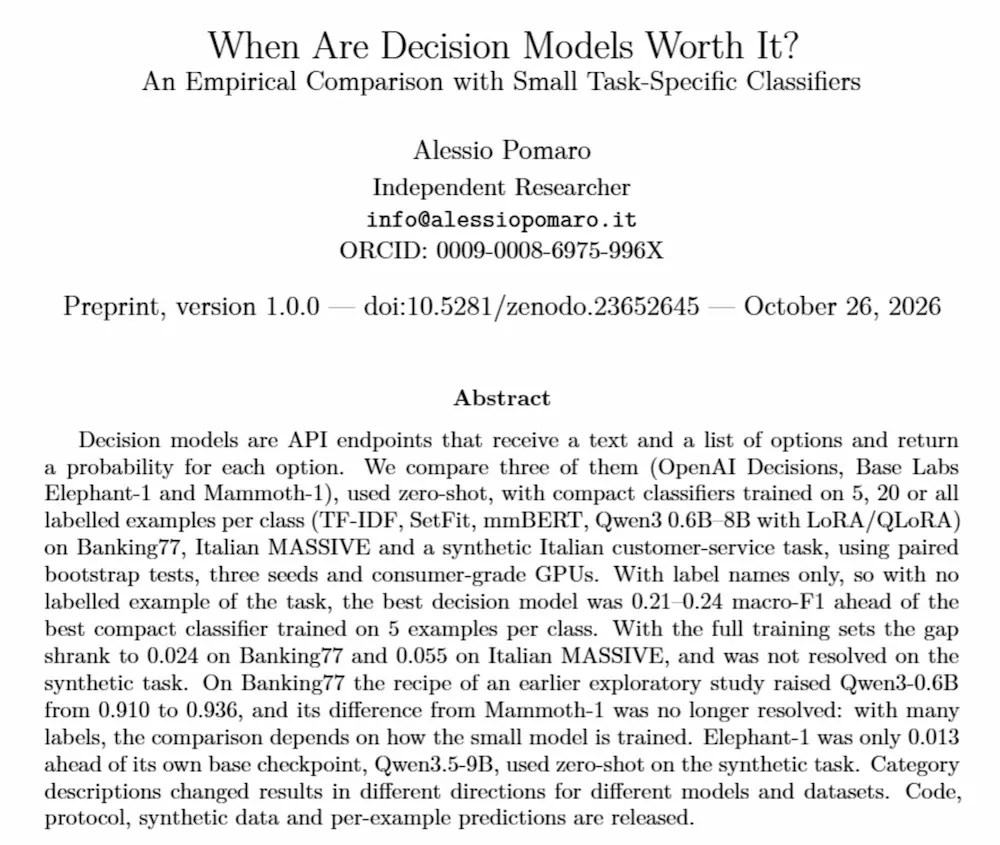
When Are Decision Models Worth It? An Empirical Comparison with Small Task-Specific Classifiers

DOI: 10.5281/zenodo.23652645
When Are Decision Models Worth It? An Empirical Comparison with Small Task-Specific Classifiers - Paper - Alessio Pomaro

I decision model sono servizi API che ricevono un testo e un elenco di opzioni e restituiscono una probabilità per ciascuna opzione. Ne confrontiamo tre (OpenAI Decisions, Elephant-1 e Mammoth-1 di Base Labs), usati in modalità zero-shot, con classificatori compatti addestrati su 5, 20 o tutti gli esempi etichettati per classe (TF-IDF, SetFit, mmBERT, Qwen3 da 0,6B a 8B con LoRA/QLoRA), su Banking77, MASSIVE in italiano e un compito sintetico di assistenza clienti in italiano, con test bootstrap appaiati, tre seed e GPU di fascia consumer.
Usando solo i nomi delle etichette, quindi senza alcun esempio etichettato del compito, il miglior decision model ha superato di 0,21–0,24 di macro-F1 il miglior classificatore compatto addestrato con 5 esempi per classe.
Con i training set completi il divario si è ridotto a 0,024 su Banking77 e a 0,055 su MASSIVE in italiano, e non è risultato significativo sul compito sintetico. Su Banking77, la ricetta di addestramento di uno studio esplorativo precedente ha portato Qwen3-0.6B da 0,910 a 0,936, e la differenza rispetto a Mammoth-1 non è più risultata significativa: con molte etichette, il confronto dipende da come viene addestrato il modello piccolo.
Sul compito sintetico, Elephant-1 ha superato di soli 0,013 il proprio modello di partenza, Qwen3.5-9B, usato in modalità zero-shot. Le descrizioni delle categorie hanno modificato i risultati in direzioni diverse a seconda del modello e del dataset. Codice, protocollo, dati sintetici e predizioni per singolo esempio sono pubblicati.

I riferimenti

Paper

"When Are Decision Models Worth It? An Empirical Comparison with Small Task-Specific Classifiers"

When Are Decision Models Worth It? An Empirical Comparison with Small Task-Specific Classifiers
Preprint, not peer reviewed. Decision models such as OpenAI Decisions and Base Labs' Elephant-1 and Mammoth-1 return a probability for each option of a closed question and need no task-specific training. This independent study asks when they are worth using instead of small classifiers trained on the task. We compare them with TF-IDF, SetFit, mmBERT and Qwen3 classifiers (0.6B, 1.7B, 8B parameters) on Banking77 (English), MASSIVE it-IT (Italian) and a synthetic Italian customer-service task, varying the label budget (5 and 20 examples per class, full training set) and the category descriptions, and testing a lexical stress set and a phenomenon-level robustness set. With few labelled examples the decision models are far ahead, even when given label names only; with the full training sets and the protocol recipes the gap is 2.4 points on Banking77, 5.5 on Italian MASSIVE and not resolved on the synthetic task, and on Banking77 a different fine-tuning recipe leaves no resolved difference, so in this regime the outcome depends on the training recipe. The effect of category descriptions varies with model and dataset, and Elephant-1 is much closer to its own base model, Qwen3.5-9B, than to an older generalist. The study uses a frozen protocol, paired bootstrap intervals and three seeds; code, per-example predictions and synthetic data are released. Limitations: no real customer messages or human annotations, synthetic data written by language models, possible contamination of public benchmarks, endpoints evaluated in October 2026. The author set the research question and the requirements of the study; an AI coding agent (Claude Code) proposed the detailed protocol, wrote the code, ran the experiments and drafted the manuscript under the author's direction. See the "AI assistance and authorship" section of the paper.

Codice e dati

GitHub - alepom/decision-models-study: Independent study: zero-shot decision models vs task-adapted compact classifiers (code, protocol, predictions)
Independent study: zero-shot decision models vs task-adapted compact classifiers (code, protocol, predictions) - alepom/decision-models-study
dmstudy: code, protocol and per-example predictions for "When Are Decision Models Worth It?"
Code, frozen protocol, split manifests, category descriptions, synthetic datasets (Ottavo Store, its lexical stress set and the Ottavo-R robustness set) and per-example predictions for every run of the study "When Are Decision Models Worth It? An Empirical Comparison with Small Task-Specific Classifiers". All tables and figures of the paper can be regenerated from the saved predictions without a GPU or API keys (python -m dmstudy.analysis, python -m dmstudy.robustness, python -m dmstudy.extras). Raw API request/response caches and model weights are not included (weights are downloaded from Hugging Face at run time). The code is released under the MIT licence; documentation, synthetic data and predictions under CC BY 4.0 (see LICENSES.md). This archive corresponds to the GitHub release v1.0.0; please cite the paper for the scientific results.